Christianity has had a long and deep presence in Egypt. From mid-thirteenth-century Egypt there survives an illuminated New Testament written in Bohairic Coptic with glosses in Arabic. It was copied in Cairo in 1249-50 by Gabriel III (born al-Rashīd Farajallāh), who would serve as patriarch of Alexandria from 1268 to 1271, for the private use of a prosperous lay patron of the Coptic Church. Cette description introduit le contexte historique et bibliographique du manuscrit copte, dont le dossier est partagé entre les collections parisiennes et cairotiennes.
La Copte-Arabe 1, comme on la nomme, est divisée entre deux lieux: les Quatre Évangiles complets à Paris (Institut Catholique, Ms. Copte-Arabe 1) et les Actes des Apôtres et les Épîtres au Caire (Musée Copte, Bibl. 94). Drawing on Byzantine and Islamic artistic influences, Copte-Arabe 1 “represents the culmination of painting in Egypt and the allied territory of Syria for the Ayyubid period [1171-1260] as a whole,” writes art historian Lucy-Anne Hunt. Cette remarque souligne l’interaction culturelle qui traverse les images et les textes du manuscrit et qui éclaire la manière dont les artistes ont intégré des éléments dotés d’un fort pouvoir narratif.
Le manuscrit contient quatorze miniatures pleine page et quatre en-têtes de Gospels. Of the fourteen full-page miniatures, four are portraits of the Evangelists (i.e., Gospel-writers): Matthew, Mark, Luke, and John. Ces portraits constituent les chefs-d’œuvre les plus raffinés et les plus célébrés de l’ensemble, et l’un d’entre eux - celui de Marc l’évangéliste - est particulièrement impactant par la présence d’un personnage secondaire, Pierre, qui lui transmet l’Évangile.
folio 65v de Copte-Arabe 1 montre Pierre transmettant son savoir intime à Marc. Traditionally, a man named John Mark is credited as the author of the Gospel that begins, “The beginning of the good news of Jesus Christ.” John Mark was a disciple of Peter, whom he is believed to have used as his primary source in composing his Gospel. Cette dynamiq ue d’école apostolique est récurrente dans l’iconographie copte, où Pierre et Marc dialoguent souvent dans des compositions proches, avec Pierre dictant ou présentant le texte à Marc.
Two such twelfth century Gospels today in Jerusalem are the Greek Taphou 56 and the Armenian Theodore Gospels (Armenian Patr. 1796), showing the standing Peter dictating to the seated Mark. Il existe donc une tradition iconographique partagée entre les communautés syriennes, arméniennes et coptes qui éclaire l’essor des portraits d’apôtres dans les manuscrits orientaux. Les figures secondaires, qu’elles soient inspirantes ou présentatrices, sont particulièrement fréquentes dans l’art copte et oriental chrétien.
Now let’s take a look at the narrative images. J’ai parcouru l’ensemble et tenté d’identifier chaque scène au mieux, les titres descriptifs précisés étant accompagnés du folio correspondant. All the image files are sourced from La bibliothèque numérique de l’Institut Catholique de Paris, qui héberge une numérisation complète du manuscrit. Si vous souhaitez reproduire les images, je propose la légende suivante: Page from a Coptic-Arabic Gospel Book, Cairo, Egypt, 1249-50. Illuminations on parchment, 25.5 × 17.5 cm. Ainsi se déploie une première séquence narrative qui ouvre sur la Nativité de Matthieu, avec Marie allongée dans l’alcôve d’une grotte et l’enfant Christ gisante à ses côtés, adorés par l’ox et l’ânesse, tandis qu’un ange observe et que les bergers et les mages approchent.
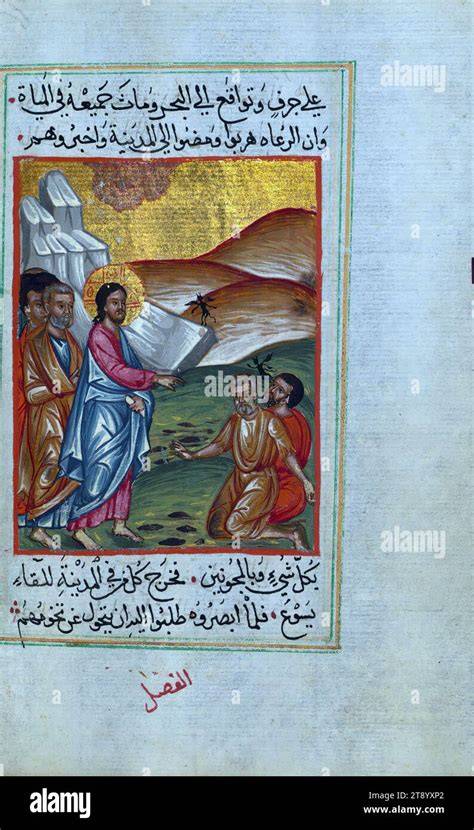
fol. 2r: The Nativity (Matt. 1:25; 2:9-11; cf. Plus loin, six pages illustrent diverses scènes tirées de Matthieu - la plus vaste suite picturale du manuscrit. fol. 4v: The Magi before Herod (Matt. 2:7-8); The Flight to Egypt (Matt. 2:13-15); The Massacre of the Innocents (Matt. 2:16-18); John the Baptist Baptizes Converts (Matt. 3:1-12); Jesus Heals a Man with Leprosy (Matt. 8:1-4); A Centurion of Capernaum Seeks Healing for His Servant (Matt. fol. 5r: The Healing of Peter’s Mother-in-Law (Matt. 8:14-15); Jesus Restores Two Demon-Possessed Men (Matt. 8:28-24); The Healing of the Paralytic (Matt. 9:1-8); The Calling of Matthew (Matt. 9:9-13); The Healing of the Woman with the Issue of Blood (Matt. 9:20-22); The Raising of Jairus’s Daughter (Matt. fol. 18v: Messengers from John the Baptist (Matt. 11:2-5); The Beheading of John the Baptist (Matt. 14:1-12); The Feeding of the Multitudes (Matt. 14:13-21); The Transfiguration (Matt. 17:1-13); Jesus Heals a Demon-Possessed Boy (Matt. 17:14-20); The Mother of James and John Requests a Favor (Matt. fol. 19r: Jesus’s Disciples Fetch a Donkey (Matt. 21:1-6); Christ’s Entry into Jerusalem (Matt. 21:7-11); The Parable of the Wise and Foolish Virgins (Matt. 25:1-13); The Anointing at Bethany (Matt. 26:6-13); Jesus Washes His Disciples’ Feet (John 13:1-17); The Last Supper (Matt. From having seen other similar compositions, I know that the man holding the scroll and gesturing toward the donkey on folio 19r/1 is the prophet Zechariah, et cetera.
fol. 56v: The Agony in the Garden (Matt. 26:36-46); The Kiss of Judas (Matt. 26:47-49); The Arrest of Christ (Matt. 26:50-56); Christ before Caiaphas (Matt. 26:57-66); The Denial and Repentance of Peter (Matt. 26:69-75); Christ before Pilate (Matt. fol. 57r: Judas Returns the Blood Money and Hangs Himself (Matt. 27:1-10); Pilate Washes His Hands (Matt. 27:24-26); Christ Carries His Cross (Matt. 27:31); The Crucifixion (Matt. 27:33-56); The Deposition (Matt. 27:57-59); The Entombment (Matt. …).
Strikingly, all the figures in this manuscript are given halos around their heads, not just holy figures - une particularité qui peut marquer la dignité humaine ou un trait symbolique de sanctification universelle. Le masque des halos peut témoigner d’un imaginaire théologique où chaque être humain porte imago Dei, même s’il s’agit d’adversaires ou de personnages profanes.
The next illumination is folio 106r, which opens the Gospel of Luke. In the first full-page miniature from Luke, the third scene confuses me un peu: I’m fairly sure it’s supposed to be the twelve-year-old Jesus sitting among the doctors of the law in the temple at Jerusalem, as narrated in Luke 2:41-51; this episode is typically included in image cycles on the Life of Christ. But here he’s shown as a full-grown adult. Ainsi, on observe une tension entre la narration textuelle et l’iconographie, typique des manuscrits coptes-arabes où l’interprétation théologique peut dépasser la simple chronologie.
When he came to Nazareth, where he had been brought up, he went to the synagogue on the Sabbath day, as was his custom. He stood up to read, and the scroll of the prophet Isaiah was given to him. Le texte de Luc 4:16-20, avec l’explication de Jésus sur les Gentils, provoque la colère de l’assistance, et les scènes suivantes montrent la réaction violente de la foule, conduisant à la sortie hors de la ville et au désir de le repousser du bord de la falaise. Mais il passe au milieu d’eux et s’en va. Ces épisodes éclairent la tension entre sagesse nouvelle et résistance conservatrice au sein de la communauté juive locale.
On the following page, in the fifth frame, the Rich Man and Lazarus is one of Jesus’s three parables depicted in the manuscript. The artist departs de la scène traditionnelle de Lazarus à l’extérieur, pour représenter l’au-delà et son jugement. The center-right scene, with a lavish interior and Jesus présent, pourrait représenter la guérison d’un homme souffrant d’un œdème au sein d’une maison de pharisien, ajoutant une dimension humaine et domestique à la narration évangélique. fol. fol. fol. 179r: The Raising of Lazarus (John 11:1-44); The Holy Women at the Tomb (Mark 16:1-8); The Road to Emmaus (Luke 24:13-27); et d’autres scènes autour de la Résurrection et de l’Ascension qui figurent dans ce folio.
Lucy-Anne Hunt, dans ses travaux sur les rapports entre Christianisme, art et Islam, met en évidence les sources et les influences croisées qui expliquent la richesse iconographique de Copte-Arabe 1, en particulier à Paris et au Caire, et leur pertinence pour comprendre l’époque ayyubide et les échanges méditerranéens. Cette étude situe le Tétraévangile copte comme un point nodal entre Bible, arts visuels et patrimoine liturgique, révélant la manière dont les manuscrits coptes furent utilisés pour l’enseignement, la dévotion privée et la démonstration de statut social des mécènes.
- Hunt, Lucy-Anne. Christian-Muslim Relations in Painting in Egypt of the Twelfth to Thirteenth Centuries.
- Hunt, Lucy-Anne. Byzantium, Eastern Christendom and Islam: Art at the Crossroads of the Medieval Mediterranean, vol. 2.
Pour résumer, le Tétraévangile copte témoigne d’un processus de modernisation artistique et théologique au sein d’un contexte multiculturel, où les échanges entre Égypte, Syrie et l’Ayyoubide ont produit un répertoire d’images et de textes qui racontent la vie du Christ tout en dialoguant avec des traditions picturales voisines. Cette œuvre est un jalon dans l’étude des rapports entre lithurgie, illustrated manuscripts et identité chrétienne dans l’espace méditerranéen.